
Approach to Care
The foundation of every patient encounter in our practice rests on a single, unwavering principle: the primary goal of treatment is the restoration of the highest possible level of function. Not merely the absence of pain — though relief from suffering matters enormously — but the return of capacity: the ability to work, to move, to perform the activities that give life its meaning and satisfaction. Every diagnostic and therapeutic decision flows from that commitment.
To achieve that goal, however, one must first arrive at the correct diagnosis. This sounds self-evident, yet it is frequently underappreciated in modern medicine, where the reflex toward advanced imaging and procedural intervention can short-circuit the most powerful diagnostic instruments available — the patient’s own words and the physician’s examining hands. The best treatment is invariably built on the best diagnosis, and the best diagnosis begins long before any study is ordered.
The patient’s history is the first and most revealing guide. Research and clinical experience alike confirm that approximately seventy percent of musculoskeletal diagnoses can be established — or at least strongly suspected — from the history alone. When did the symptoms begin? Was there a specific mechanism of injury, or did discomfort develop gradually over time? Where precisely does it hurt, and does that pain radiate? What makes it worse, and what brings relief? Does it awaken the patient at night? Has it changed in character since onset? These questions, asked with patience and genuine curiosity, tell a story. The physician’s task is to listen well enough to hear it. In an era when clinical encounters are too often compressed into minutes, the deliberate act of listening is itself a therapeutic and diagnostic discipline.
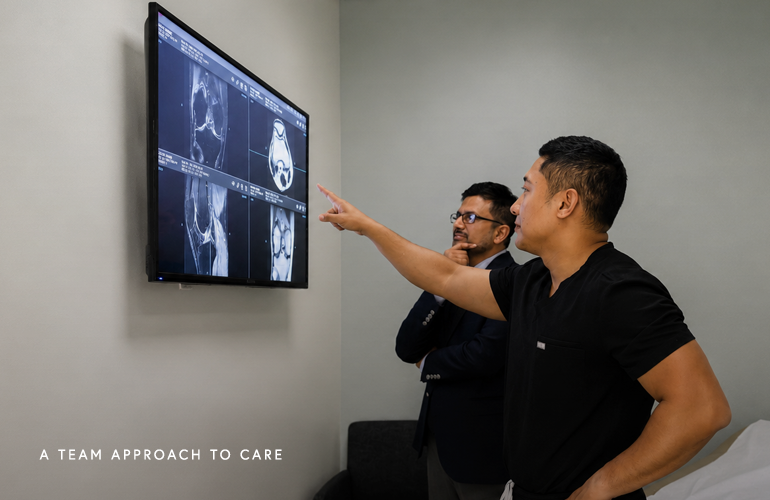
The physical examination then brings precision and confirmation to what the history has suggested. A carefully performed examination — palpating for tenderness, assessing range of motion, applying specific provocative tests developed and validated over decades of orthopedic and sports medicine practice — can confirm the working diagnoses generated by the history and add clarity in an additional twenty percent of cases. The hands of an experienced clinician remain remarkable instruments. They locate the exact anatomical source of pain, distinguish between competing diagnostic possibilities, and detect findings the patient may not have thought to mention. History and physical examination together, therefore, account for the great majority of what we need to know.
Advanced imaging — musculoskeletal ultrasound and MRI in particular — then enters the picture not as a substitute for clinical reasoning, but as its refinement. These high-precision studies add the granular anatomical and structural detail that sharpens a diagnosis already established by history and examination. Ultrasound offers dynamic, real-time visualization of tendons, nerves, and soft tissues with a level of resolution that continues to redefine what is clinically detectable. MRI provides unparalleled soft tissue contrast and cross-sectional anatomy at deeper levels. Used in proper sequence, they answer the specific questions the clinical encounter has already raised — confirming the extent of a tear, characterizing a lesion, mapping anatomy prior to an intervention.
This is the clinical method: listen first, examine carefully, image precisely. Each step builds upon the last, and each is in service of the one goal that never changes — returning the patient to the fullest life possible.